As
promised , here is a bit more complicated composite than the last, and one that
adds a visual effect for managing audience focus. This effect is the simulation
of a depth of field.
Depth of field refers to the part of the scene
"that appears sharp in the image."
Although a lens can precisely focus at only one distance, the decrease
in sharpness is gradual on either side of the focused distance, so that within
the DOF, the unsharpness is imperceptible under normal viewing conditions.
If you have two subjects on distinct planes, however, a blur begins to become
noticeable.. At first, filmmakers viewed this as an obstacle to be overcome by
technique, then began to use these techniques to help manage audience focus. As
a consequence, filmed scenes tend to be a hybrid of the kind of audience
focus-management you see on a theatrical stage (where cutting from longshot to
closeup is impossible), and the kind of focus management available to
filmmakers exclusively (I want you to focus on the face and nothing else, so I
cut to that face.)
We could say that the theatrical technique lacks certainty, the cinematic
technique lacks subtlety.
Film directors early on noticed that managing audience focus as it is done
onstage has a certain elegance: no jarring cuts, little confusion over who
we're looking at or what they're looking at or what's going on with the rest of
the scene. Onstage, directors manage audience focus through placement of
actors, the use of lighting, who is the focus of other actors' attention, and
so on. There is the concept of "upstaging," where an actor steals the audience
focus belonging to another actor. It is called "upstaging" because the actor
standing furthest away from the audience will require other actors interacting
with him to turn their backs slightly to the audience.
Using a selective focus - manipulating the depth of field - gave film directors
the ability to
gently push audience focus around the screen without
cutting the film, and without having to implement the kind of stagecraft tricks
that Orson Welles was famous for because, well, he was a stage director who
became a film director and he really knew his stage tricks.
In the
McO Filter , shot on a Panasonic HVX100 camera, there is no
depth of field limitation, so this ability to push audience focus gently around
the screen is not possible in production. But in post-production we can add the
effect as if there had been an actual assistant cameraman on the set twisting
the little focus ring.
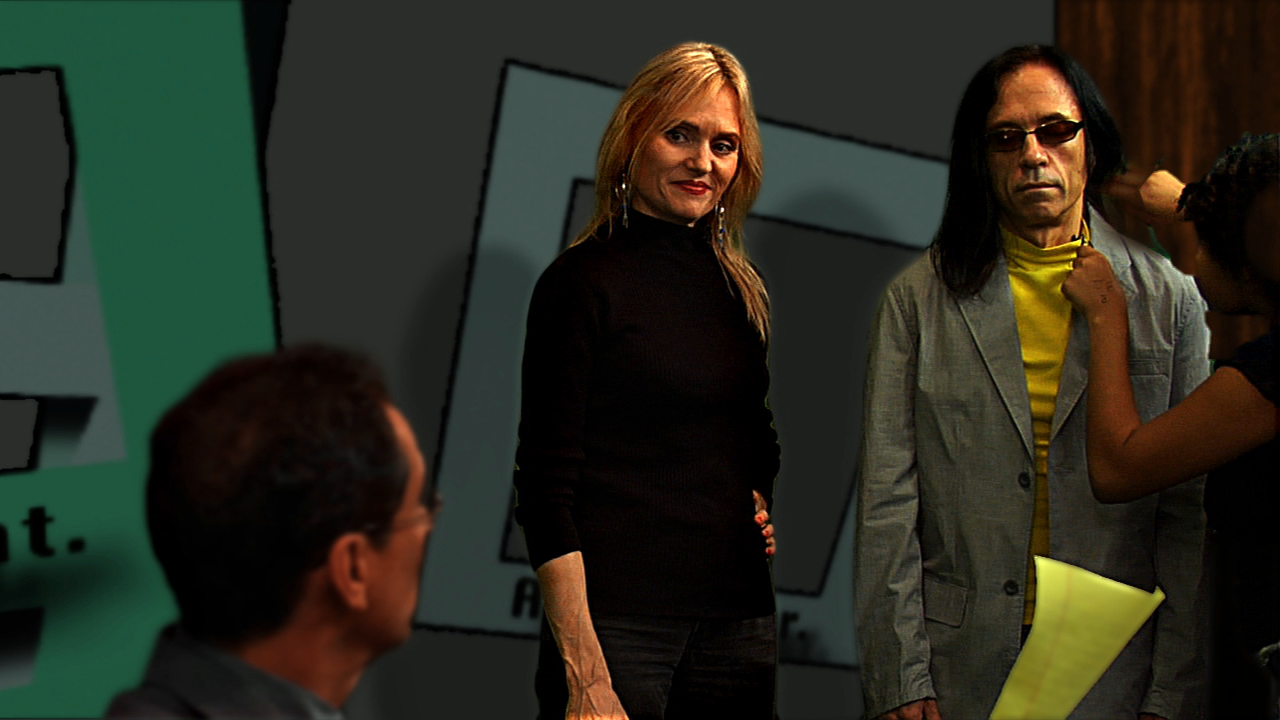
Here are the components of the composite. First, the foreground shot in front
of a green screen.
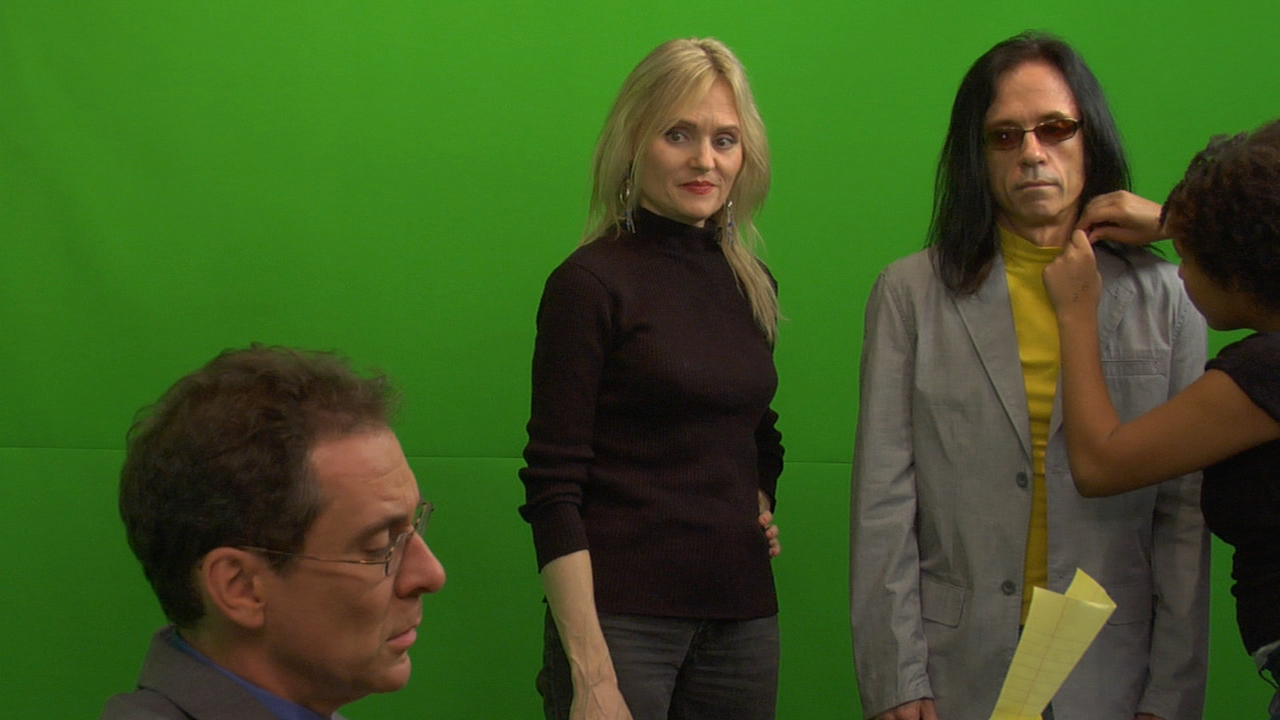 Frame 1: Foreground: the set of the McO Filter. Left
to right: Charles Willey, Judy Chesnutt, Dan Roentsch, Elektra Yao
Frame 1: Foreground: the set of the McO Filter. Left
to right: Charles Willey, Judy Chesnutt, Dan Roentsch, Elektra Yao
The actors are acting as if they are in a television studio, instead of in a
tiny rehearsal stage near Madison Square Garden. This shot is a "behind the
scenes" shot. During a commercial break, Lamprey McO (Charles Willey) sits
reading over his copy, while his next two guests are preparing to be seated for
the next segment of the program. One of the characters, Vicki Crofts (Judy
Chesnutt), is staring at McO. She's waiting to see if he'll look over at her.
This
is the background that will replace the green screen.
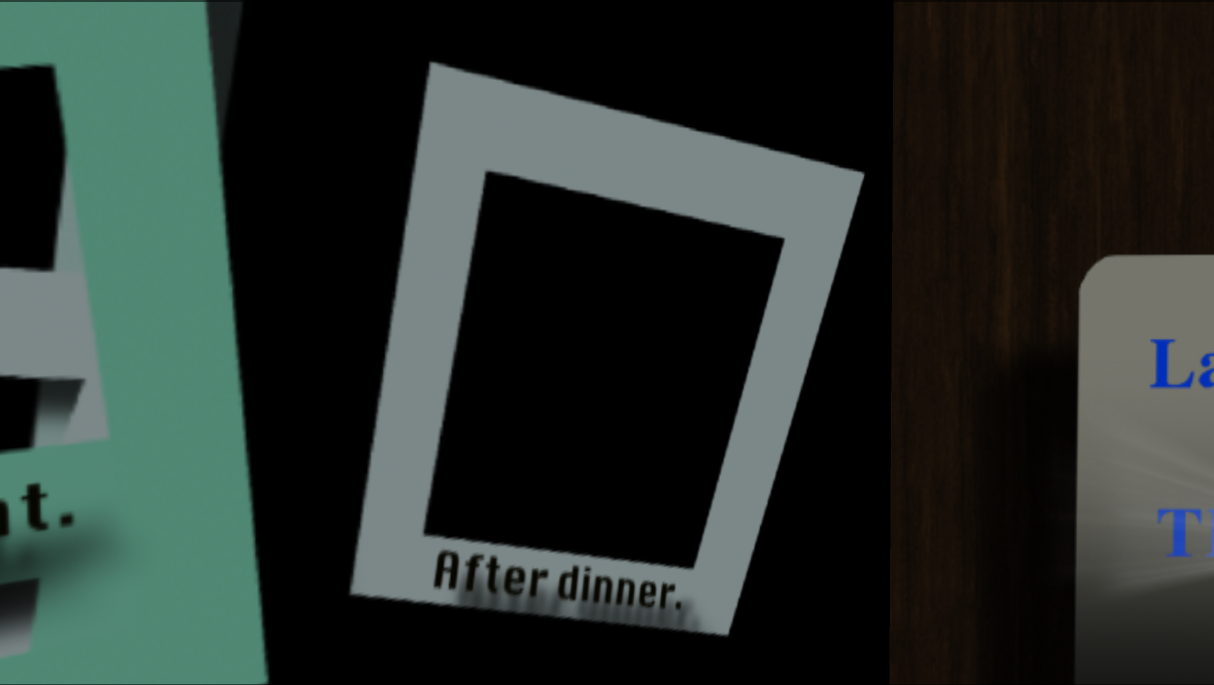
That's right. Weird squares with the show's slogan -- "Every Night. After
Dinner." -- on them.
Now a word about how these backgrounds were concocted.
First, I created the show's opening theme in Studio Pro's Motion application.
In this application, the weird squares and slogans are dancing around on the
screen to majestic music that says, "we mean business." You know, the loud
trumpet sounds that typically accompany the entrance of Roman emperors and
American news anchors.
I took a still of this animation and saved it as the back wall of the McO Filter
set. For the side walls, I also used stills of graphics composed in Motion.
I then exported these stills toa 3D modeling program, in which I had built a
wireframe model of the full-sized studio set we shot the movie on. Once the
Motion images were projected onto the walls in the 3D wireframe, I used a
virtual camera set at the same angle and distance as the actual camera that
shot the actors. The "snapshot" of these joined images is what you see above.
I then opened Shake and imported this snapshot, compositing it with the
foreground. You see the color-corrected results below.
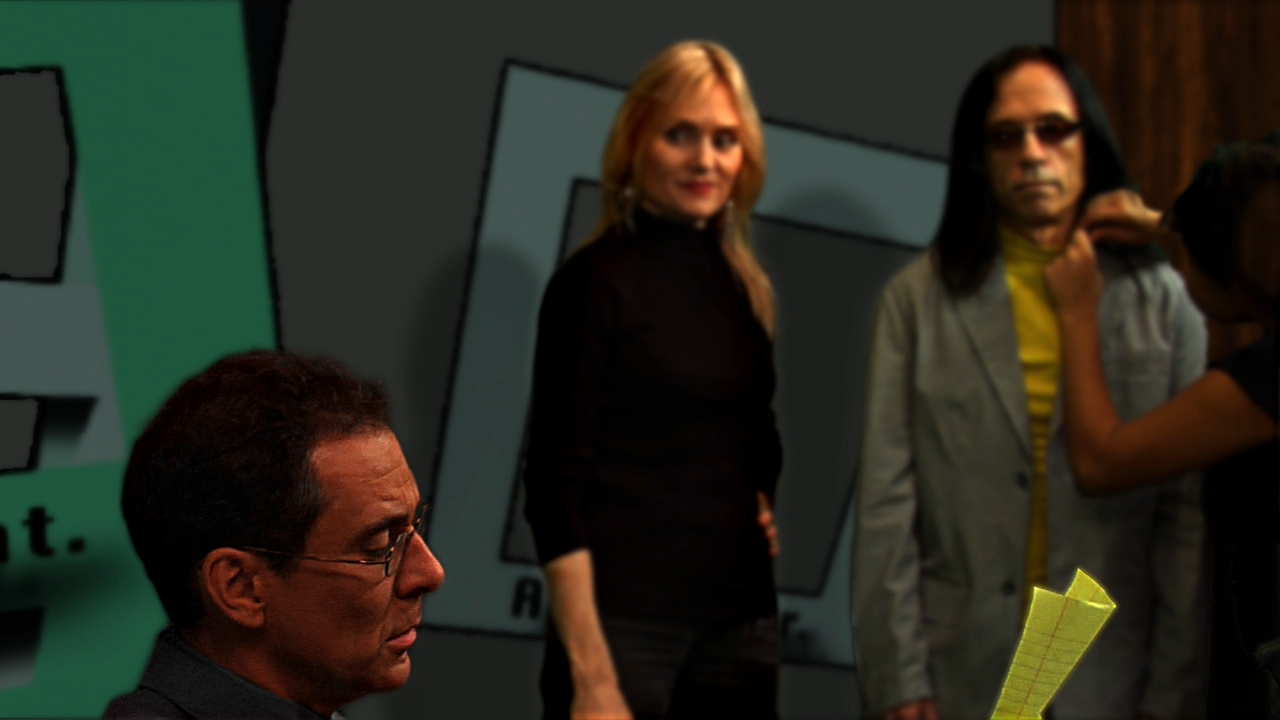
Notice the neat shadow that the characters cast on the back wall? The wall that
wasn't there? That's pretty cool. But the hardest part of this is the hair. I
know I've said that in an earlier post, but it bears repeating. And take a look
at Judy's hair in the above shot. It's blond. Blond is a kind of yellow. Yellow
has green in it. When you take the green out of an image to replace it with the
background, how do you keep from turning her hair orange? How do you keep from
turning the sheet of legal paper orange? How do you keep the turtleneck on the
really cool, handsome guy with the shades from turning orange?
But I digress. Look at the blur on the characters in the background. That
wasn't there in the original shot. I put it there to simulate a selective focus
on the foreground objects -- Charles Willey's head and the sheet of paper he's
holding.
Now he turns to look at Judy.
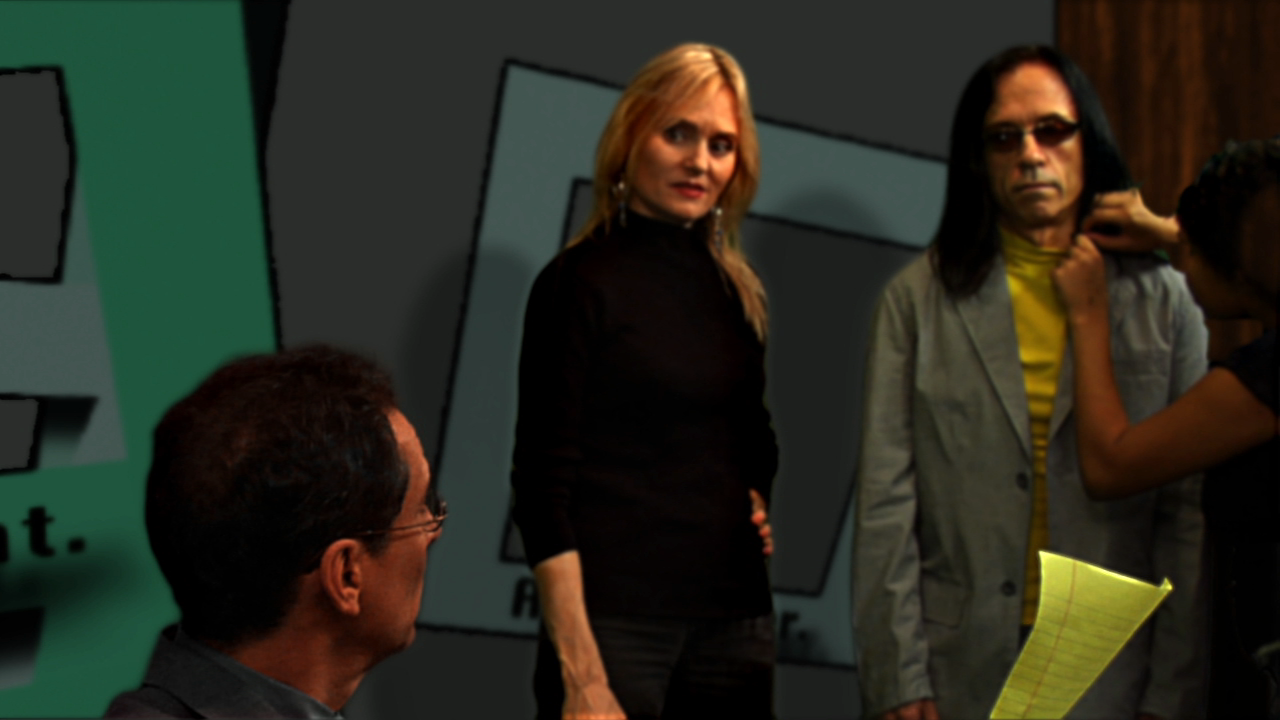
Notice in the above frame the blur is about evenly shared between foreground
and background. And in the frame below, foreground is blurred while background
comes into focus.
This was all done at a computer long after the actors had gone home, cashed
their checks, and stopped replying to my email. The program: Shake. The
computer: an Apple G5. (Did you ever notice that when you had to take Internet
Explorer with Windows it was a felony, but when you are forced to take an
entire hardware platform with OS X it's like, cool, dude? -- But again, I
digress.)
How this is usually done with a film camera is that the two focal points are
determined prior to the shot, then the assistant camera individual rotates the
focus ring on a given count in response to a given cue. If he screws it up
somehow (which he could never do if he is a dues-paying union member), you have
to re-take the shot. Add to that the fact that you (probably) have to pay
him/her, and he/she will no doubt be consumuing his/her share of bagels,
donuts, and coffee whenever he/she is not in the actual process of rotating the
focus ring. Oh yeah. And don't forget lunch.
Personally, I prefer the doing-it-at-the-computer approach.
The next entry should be simlilarly mind-blowing in content.